 Solutions to Results
So Much to Do and So Little Time: Achieving Success in the C-Suite
By Steven E. Sacks, CPA, CGMA, ABC
There is no one right way that leadership can be defined. A high-level title is not a definition. Neither is continuous delegation of work without context nor unilateral decision making.
Leadership is about attitude, influence, coaching, creating and sharing; a conscious awareness of mission and walking the talk in values. In a word, leadership is an art. This differs from management, which is basically a science that produces quantifiable results that can be measured against expectations.
Leadership implants a sense of purpose with staff to build a greater commitment in its work; it creates an emotional, as well as an intellectual investment. Instilling the “why” instead of the “what” in your staff allows it to have a sense of fulfillment and purpose, not just a means of checking an item off a “to do” list.
Technology companies over the past 25 years have exhibited this philosophy. There are those who put the stake in the ground with goals that have been uplifting. Apple set out to change the world. IBM recovered from missed opportunities with its campaign to build a smarter planet. Google, well, we know about Google. It is not only a brand but has morphed into a verb.
Are leadership skills inherent or can they be taught? The answer is yes. Those in power who have a sharp eye can see the potential and can cultivate the necessary components to allow the potential to be realized. This of course depends on the culture of your organization and its alignment with a well-defined mission and aligned goals and strategies.
Not Everyone Succeeds
Reaching the C-Suite is not the culmination of your career; instead, it is the beginning of one. You have responsibilities for financial and human assets. Both have to be addressed equally whether yours is in a corporation or a CPA firm. With the former, you answer to investors, shareholders, lenders and direct reports, among others. With the latter, when you reach the position of partner, you are no longer an employee; you are an owner, with all the attendant responsibilities for managing and honing your direct reports; you create a process for succession, developing new business and running a profitable practice.
Why do some falter in a new leadership role? Were they not adequately prepared? Maybe. Did they dream about it, but didn’t see the foundational cracks? Possibly. Did they go at 60 mph to get to the C-Suite and could not put the brakes on? Could be. Or maybe there are other reasons.
Having the Courage to Lead
As said earlier, there is not one definition for leadership. However, there is undeniably one element that must exist: Courage.
Lee Eisenstaedt, founder and CEO of Chicago-based Value Drivers, LLC published a book in 2016, Being a Leader With Courage: How to Succeed in Your C-Level Position In 18 Months or Less. Eisenstaedt twice worked in two C-Suite functions simultaneously, the first time in a U.S. company and the other in the France. So not only did he need courage, but he had to learn be adept in multiple cultures. For his book, Eisenstaedt undertook extensive research about leaders who moved into the C-Suite and what it took for them to survive and thrive. From here, he created a proprietary assessment of behaviors that new and emerging leaders need to be aware of.
Culture first. Culture last. Culture in between.
In order for courageous leadership to effect positive change, there must first be a solid culture. “Today’s leader needs to identify, explain and demonstrate the company’s values,” Eisenstaedt says. “Values need to be documented in language that clearly articulates what’s expected of everyone. These are not merely suggested behaviors, but guidelines to be followed in order to be a part of the organization.” Adds Eisenstaedt, “Values pass on from generation to generation, and the actions taken and decisions made are based on truths that stand the test of time. You will see the culture begin to erode when there is inconsistent compliance with values, irrespective of people’s positions.”
The following is an example of how one company Eisenstaedt knows acknowledges its employees’ compliance with core values. While it has elements of humor, the message is rather pointed.
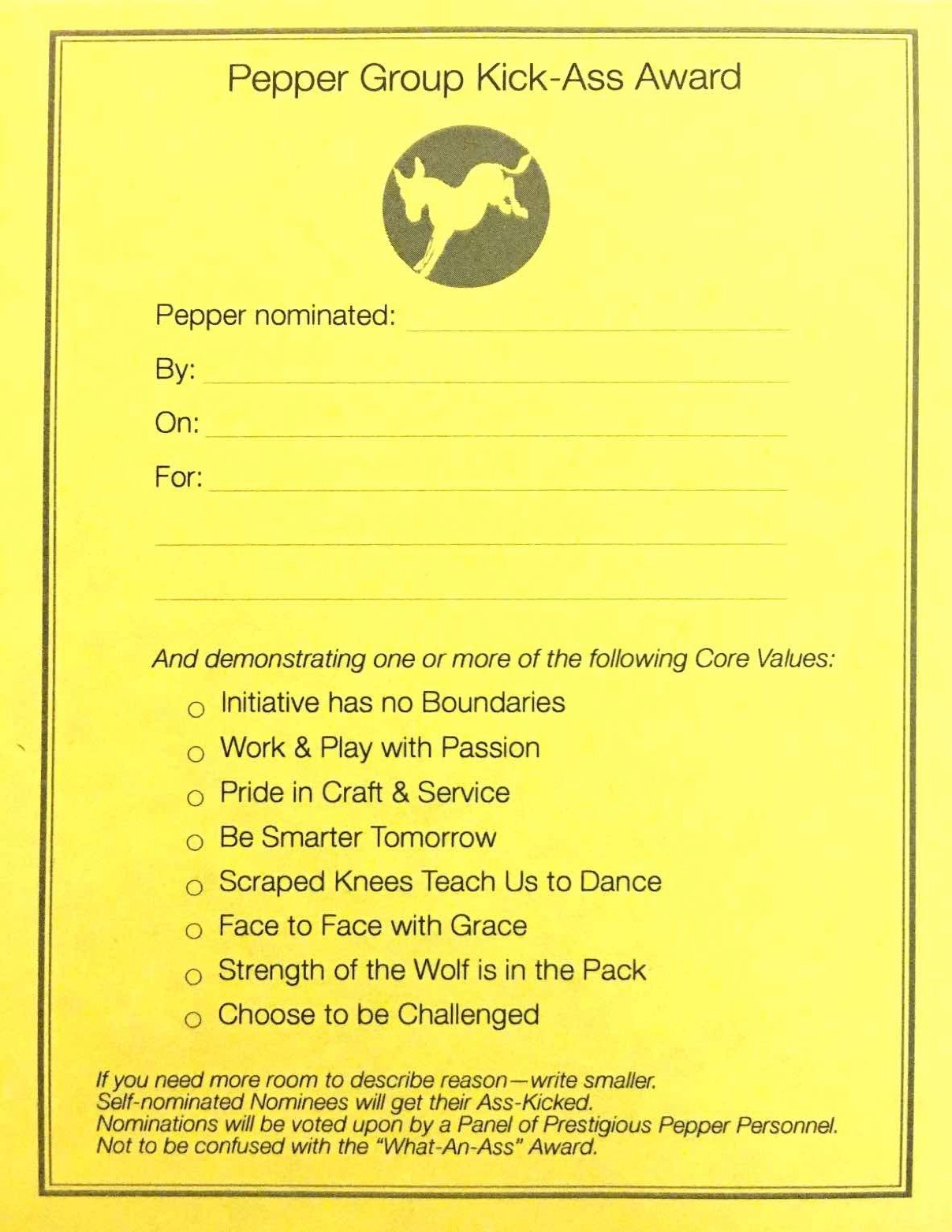
There is no single magic bullet for wholesale cultural improvement, imposing limits on the right course of action. “Attempting to modify a culture is a strategy of the last resort,” Eisenstaedt stresses. “A new leader is better off to learn as much as possible about the company’s current culture, including its strengths, weaknesses, motivators and constraints. From here, you focus on the strengths and downplay the weaknesses.”
Culture involves humans and is impacted by diverse strengths, weaknesses, desires and goals. It is difficult to apply a mathematical correlation between successful strategy implementation and culture. It can however, easily be assessed by comparing anticipated performance to expected outcomes.
Eisenstaedt says that culture must be monitored to understand the health and engagement of your organization as it is implementing its strategies. “I have learned that whenever we have tried to develop and implement a strategy without first having assessed the health of the organization’s culture and reflecting those learnings in the plan, the strategy usually fails to deliver the intended results. Strategy just hints at the company’s story, while culture requires a common language that explains the company’s story, including its vision, mission and values,” explains Eisenstaedt.
There is the oft-stated philosophy of “tone from the top.” But is a healthy culture just the responsibility of company leaders because of their position of influence? “Employees at all levels,” Eisenstaedt observes, “contribute to the culture by being familiar with it, committed to behaving in accordance with it, and helping their fellow employees do the same thing.” The proof of the pudding is when employees are in doubt or no one else is around, the organization’s values guide their decisions and behavior.
Self-Awareness is Crucial
Building off his book, Eisenstaedt created a Leading With Courage Workshop. A crucial element of this workshop is the emphasis on leaders gaining more self-awareness. “Being self-aware of how others perceive your behavior, your technical strengths and opportunities for improvement is an essential quality of an effective leader,” Eisenstaedt says. “Because a leader’s behaviors, attitudes, and answers have an impact on so many people, great leaders are open to constructive feedback, are continuous learners, and are not afraid of asking ‘how am I doing?’ of employees, customers, vendors, and other stakeholders. They can’t assume they know the answer or feel threatened or challenged when their perceptions are different from those they work with or influence.” He notes that it does not stop at this point. The leader, once aware of this feedback, needs to determine if this is how he or she wants to be perceived and what actions, if any, need to be taken.
Tomorrow’s Leaders
A new generation of leaders is taking hold and will continue to over the next decade. Will globalization and the further embedding of technology in our daily lives change how leadership is defined and practiced? “I don’t know that my philosophy today and in the future will be different,” Eisenstaedt says. “Based on our research for the book, effective leaders need to be astute generalists, all-star relationship builders, champions of the culture and competitive advantage, and courageous decision makers. I don’t know that this will change going forward.” Eisenstaedt believes how we define each trait may be different, but the related attributes will probably be the same.
“Attributes, such as a passion for curiosity, being a good listener, caring about others, keeping an open mind, and holding people accountable for their commitments,” Eisenstaedt maintains. “We identified 26 attributes, and in thinking about them, I believe they’ll stand the test of time.”
Leading With Courage Workshop
| Eisenstaedt has assembled a group of 14 certified executive coaches. They are a diverse group in terms of gender, race, and industry. What distinguishes them is how each has experience in the C-suite and none of them started out as consultants. For example, one was a coach in major league baseball and went to the World Series three times. Another works almost exclusively with family-owned businesses. A third served two terms on the board of a Big 4 CPA firm. Another ran the global diversity program for the world’s largest retailer, while another ran the Midwest distributorship of a high-end kitchen appliance manufacturer. The group includes an attorney, two CPAs, three marketers, a former priest, a college professor, and several PhDs. For more information about the workshop and how it can benefit your organization, click here or email Lee Eisenstaedt at Lee@ValueDriversLLC.com. |
About Steve
Steven Sacks is the CEO of Solutions to Results, LLC, a consultancy that specializes in helping individuals, firms and organizations meet the challenges of communicating with clarity and purpose. Visit his website at www.solutions2results.com.
