 Solutions to Results
My Neighbor: An American Hero
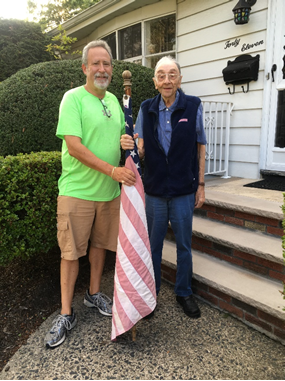
Right, Sgt. Irv Bienstock (ret.); left author.
My Neighbor: An American Hero
By Steven E. Sacks, CPA, CGMA, ABC
My posts over the past year have focused on the CPA profession as a whole, firms and issues that individual professionals face in a rapidly changing business world. I covered topics ranging from staff retention and leadership to business development and employing effective communications.
How many times have these topics been addressed seven ways ‘til Sunday? So I thought I would take a break and focus on something that focuses on history, which unfortunately seems to repeat itself.
Irv Bienstock has been both my next-door neighbor and friend for 16 years with quite a story to tell. “Beeny” was how Irv was addressed by superiors, peers and subordinates serving our country in World War II as an 18-year-old, front-line combat medic in the initial wave on Omaha Beach on D-Day, June 6, 1944.
How did this come to pass?
Irv received his draft notice in April 1943, informing him that when he turned 18 in July of that year he would receive orders to report for training. The global war was nearly four-and-a-half years old and our country’s involvement was slightly over a year-and-a-half at that point.
Reporting for duty in the Army, Irv was assigned to a newly formed Combat Engineer Battalion. In civilian life he had been working as a finisher for Steinway pianos. It was thought that his woodworking skills would have some engineering value. After some training in Camp Crowder in southwest Missouri, the youngest soldiers, including Irv, were selected to be trained as army medics. So off he went to O’Reilly General Hospital in Springfield, Missouri.
Irv underwent eight months of intensive training at the hospital. The training was led by a colonel who was a Cherokee Indian. The colonel, who was in his mid-30s at this time, had been the head physician on his reservation in civilian life. The training for this group of medics included handling fractures, giving blood transfusions, suturing wounds, surgical and other necessary skills.
A short stint at Camp Campbell in Kentucky was followed by a trip to Boston Harbor in May 1944. He then began the journey to England. During his training, his skillfulness resulted in promotions from private to corporal and then to sergeant — all in the span of eight months.
Irv went from a ship carrying nearly 15,000 men to a landing craft. His landing craft, like many others, stopped short of the ideal area when it opened the landing ramp. Rough weather raised the water level. Carrying all the necessary equipment and being a diminutive five-foot-six, 128-pound medic, Irv immediately submerged. Two GIs saw this and they lifted and carried him to shore. From this point forward, everything he learned and practiced was on auto drive, along with the art of survival.
When I spoke with Irv about doing a piece on him, it was not my intention to chronicle the first few minutes, hours, days and beyond. It was simply to share with readers a bit of what we discussed.
In all my discussions with him over the years, I never asked about the specifics of what he witnessed, how he handled the wounded, or the atrocities he observed. There are topics that are shared voluntarily only if the inclination is there. If not, then we leave the memories untouched and untarnished.
There are some things that stay with you for an entire life. While Irv may have shared them with fellow veterans over the years, they were/are the only cohorts who could really understand the unfathomable.
Irv performed his role professionally and competently. Whether it was treating fellow soldiers or an injured enemy soldier, Irv proudly and capably adhered to the tenets represented by the Red Cross patch worn on his uniform sleeve.
You Can’t Make This Up
Irv has visited a number of high schools over the years at the request of teachers to speak to students about what they will never read in textbooks. He says you can always hear a pin drop because the students are mesmerized by his presentation. Lunch usually follows and the kids pepper Irv with more questions. However, he has made it clear through the years there are certain things he will not discuss and questions he will not answer. Even so, here is one of those rare times that iPhone texts and photos are ignored, and instead, complete and rapt attention is paid.
Movies over the years tried to recreate the horror of what awaited our troops and allies in crossing the English Channel. There were other countries joining the U.S. forces in this massive undertaking.
Included were those from Belgium, Czechoslovakia, France, Greece, the Netherlands, New Zealand, Norway and Poland. Thus, the onus was not solely placed on the U.S., though the bulk of the invasion was conducted by American and British soldiers.
Irv’s experience in D-Day was followed later during the Battle of the Bulge. In Bastogne, he was hospitalized with frostbite. While recuperating, he continued to assist other medics treating the wounded.
In the future when we observe Memorial Day, Fourth of July and Veterans Day, stop to think about the sacrifices that were made and are continuing to be made by our men and women in uniform.
We have a lot to be grateful for, and we salute those like Irv who represent the best of America.
About Steve
Steven Sacks is the CEO of Solutions to Results, LLC, a consultancy that specializes in helping individuals, firms and organizations meet the challenges of communicating with clarity and purpose. Visit his website at www.solutions2results.com.
